Monday, 18 July 2011

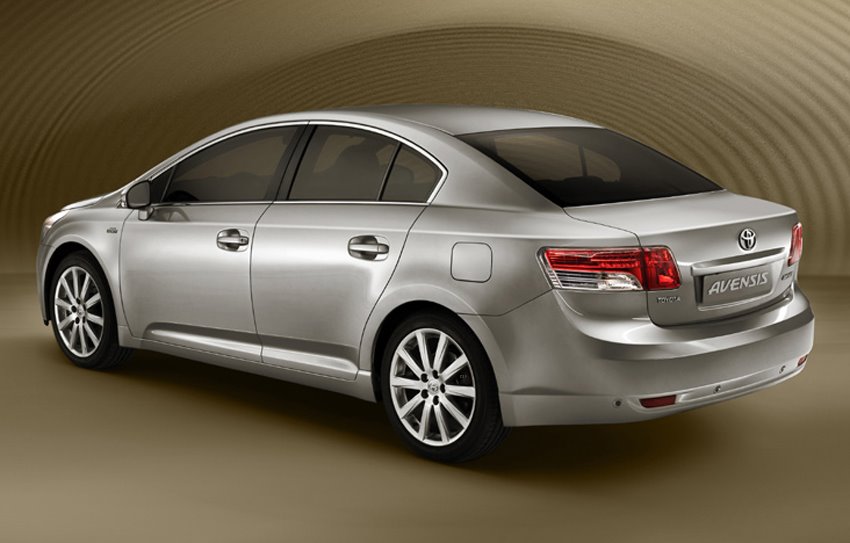
Toyota Avensis Car Review

The Toyota Avensis is a large family car built in Derbyshire, United Kingdom by Japanese carmaker Toyota since 1997. It is the direct successor to the Carina E and is available as a four-door saloon, five-door liftback and estate. A large MPV called the Toyota Avensis Verso (Toyota Ipsum in Japan and previously the Toyota Picnic in other markets) is built in Japan on a separate platform. The Avensis is the basis for the youth-oriented Scion tC, which is produced for the US market.

The Toyota Avensis was introduced in 1997, to create a more modern name when compared with the reliable, but dull Toyota Carina E/Toyota Corona. Like its predecessor the Avensis was reliable, and proved a sales success for Toyota Europe. Over the years, the Toyota Avensis has advanced in size, technology, power, and economy to challenge its worldwide-known rivals, like the Mazda6, Ford Mondeo, Volkswagen Passat, Opel/Vauxhall Insignia, Citroën C5 and Peugeot 508.
Toyota Avensis
Toyota Avensis
Toyota Avensis
Toyota Avensis
Toyota Avensis

First generation (1997–2003)

First generation

Toyota introduced the Avensis nameplate on its new model, which was launched at the end of 1997. Although an extensive revamp of the previous generation Carina E, the only main common parts were the engines, with an all new style of body. The car was built at the Burnaston factory in Derby. At the same time, production of the five-door Toyota Corolla also started at the British plant.

The original Avensis had the option of four engines (1.6, 1.8 and 2.0-litre petrol and a 2.0-litre turbodiesel) and three body styles (saloon, hatchback and estate). The station wagon was essentially the Japanese-market second generation Toyota Caldina. All of the range gave solid build quality, excellent reliability, a spacious comfortable interior, generous equipment, smooth ride quality and good refinement, but very little in the way of excitement. A facelift in mid 2000 (which saw the engines fitted with variable valve timing) made little difference to this, although a sporty Avensis 2.0 L SR with bodykit and tuned suspension did become available.

Engines

Avensis Verso

The Avensis Verso large MPV was introduced in 2001, with room for seven occupants and 2.0-litre engines only. The Verso's platform previewed the Avensis second generation. The Avensis Verso won Australia's Best People Mover, where it is simply called Avensis, the other variants unavailable to that market.

Second generation (2003–2008)

Second generation
Toyota Avensis II Fließheck Vorfacelift front.jpg
Production 2003-2008
Wheelbase 2,700 mm (106.3 in)
Length Estate: 4,715 mm (185.6 in)
Others: 4,645 mm (182.9 in)
Width 1,760 mm (69.3 in)
Height Estate: 1,525 mm (60.0 in)
Others: 1,480 mm (58.3 in)
Related Scion tC
UK-spec 2004 Avensis

The second generation Toyota Avensis (model code T250) was launched in early 2003 in an all-new format; this time it offered more in the way of driver involvement and visual appeal. Like the Toyota Echo and Toyota Corolla, it was penned by the company's design studio in France.[3] The 1.6, 1.8 and 2.0-litre petrol and 2.0-litre turbodiesel engines were carried over from the previous Avensis, and the 2.4-litre four-cylinder from the Camry was also added to the range. This was the first Avensis to be exported to Japan. Due to the Camry Wagon ending production, the Avensis Wagon is exported to New Zealand, in both 1.8 and 2.0-litre forms. In Britain, there were no 1.6 versions available.

In the 2004 European Car of the Year contest, the Avensis was just edged out by the top three, Fiat Panda (Winner), Mazda3 (2nd Place) and the Volkswagen Golf (3rd Place). However it won the 2004 Semperit Irish Car of the Year. What Car? awarded the Avensis as the "Best Family Car" for 2004 and 2005.

Following the withdrawal of the Toyota Camry in 2004 (2005 in Switzerland), the Avensis became the largest Toyota saloon sold in Europe.

Trim levels in the UK are the T2, T3-S, T3-X, T4, T Spirit, T180 and the TR. There is also a special edition, based on the T2 called the Colour Collection. In Ireland there were five trim levels - Terra, Aura, Strata, Luna, and Sol.

The original 115 PS (85 kW) D-4D Diesel engine has been complemented with a 2.2 L D-4D in 136 PS (2AD-FTV) and 177 PS (2AD-FHV) versions. Newer versions have dropped the "D-4D" and "2.0" badging from the front wings and tailgate respectively.

In Japan, the Avensis is sold as 2.0 Xi, 2.0 Li, and 2.4 Qi. Only the base model 2.0 Xi is offered with 4-wheel drive.

In 2003, the Avensis became the first Japanese vehicle to receive a 5/5 stars rating under the Euro NCAP's redone testing, with 34 total points it also became the highest rated vehicle they had tested. The 2003 Avensis also became the first vehicle sold in Europe with a knee airbag.

This is first and only one generation of Avensis sold in Egypt and Morocco, not in Persian Gulf countries.

The Avensis Verso continued to be available alongside the new Avensis until 2006. A replacement to take over from the Avensis Verso, Toyota Previa and Toyota Sienna has yet to be unveiled, but is rumoured to feature Toyota's 2.2-litre D-4D engine.

The new facelifted Toyota Avensis became available in June 2006. Some changes from the old model are the inclusion of turn signals in the side mirrors, an MP3/WMA/ASL-ready audio system, new front bumper, and a new grille. Interior materials and cloth seats have also been changed for 2006. Its multi display with on-board computer will be integrated in optitron display and is navigation ready. Also added are automatic headlights and a height-adjustable front passenger seat.

The most notable mechanical difference is the addition of a 124 bhp (92 kW) D-4D engine. This, coupled to a six-speed manual gearbox, has lowered fuel consumption, emissions, and gives a quoted 0-60 mph time of 10.5 seconds.

Engines

Third generation (2008–present)

Third generation
Toyota Avensis front 20090814.jpg
Production 2008-present
Wheelbase 2,700 mm (106.3 in)
Length Estate: 4,715 mm (185.6 in)
Others: 4,645 mm (182.9 in)
Width 1,760 mm (69.3 in)
Height Estate: 1,525 mm (60.0 in)
Others: 1,480 mm (58.3 in)

The third generation Toyota Avensis (model code T270) was revealed at the 2008 Paris Motor Show, before going on sale in January 2009. Like the previous model it is built at Toyota's Burnaston plant in Derbyshire, England.

Toyota ED2 initially designed the Avensis giving it a more sleek and athletic stance. Coefficient of Drag (Cd) figures are 0.28 for the sedan and 0.29 for the wagon body. Other design goals were to create the most comfortable suspension in its class while still offering sporty handling. The Avensis continues to use front McPherson struts and rear double wishbones. Unlike previous Avensis models, there is no five-door hatchback in this line-up.

Major options include bi-xenon HID headlamps, Adaptive Front-lighting System (AFS), and adaptive cruise control.

For safety, seven airbags are standard, including two front row side torso airbags, two side curtain airbags for both rows, and a driver’s knee airbag. For rear collisions, active front headrests designed to help reduce whiplash are standard as well as brake lights that flash under emergency braking. Vehicle Stability Control+ (VSC+) applies torque to the steering wheel to aid the driver in steering. A Pre-Collision System (PCS) becomes optional which includes Lane Departure Warning (LDW) and Lane Keeping Assist (LKA).

The Avensis received a five star rating (5/5 stars) under the latest Euro NCAP ratings scheme with an 81% overall score and a 90% score for adult occupant safety.

Engines

The Avensis offers three petrol and three diesel engine options. The new engines feature more power and lower CO2 emissions.

The new ZR engines became the first to introduce Toyota's Valvematic technology. (Correction needed)

  • 1.6-litre 1ZR-FAE 132 hp (98 kW)
  • 1.8-litre 2ZR-FAE 147 hp (110 kW)
  • 2.0-litre 3ZR-FAE 152 hp (113 kW)
  • 2.0-litre D-4D 126 hp (94 kW)
  • 2.2-litre D-4D 150 hp (112 kW)
  • 2.2-litre D-4D 177 hp (132 kW)

All engines are mated to a 6-speed manual transmission while the 1.8 L and 2.0 L petrol engines are available with a Multidrive S CVT transmission. The 2.2 litre D-4D 150 hp engine is available with a 6-speed automatic transmission.

Motorsports

On 2 August 2010 it was announced the British Touring Car Championship's NGTC prototype car will be built around the Toyota Avensis.

Series organiser TOCA, which will fully introduce the new low-cost NGTC technical regulations in 2011, said that the Japanese manufacturer would supply a donor car and a new body shell to the programme.


Thursday, 14 July 2011

Aston martin vantage v8 Super Cars

Aston martin vantage v8

Mustang Giugiaro concept

Mustang Giugiaro concept

Jaguar RD6 Concept Top Speed Cars

Jaguar RD6 Concept
Jaguar RD6 Concept
Jaguar RD6 Concept
Jaguar RD6 Concept

R-D6 also takes advantage of Jaguar's lightweight structure strategy, as pioneered in the new XJ saloon. Using aluminium and composite materials for the chassis and body, R-D6 weighs just 1500kg. This allows it to capitalise on the power - and, more importantly, the torque - delivered by its V6 engine.

And it's the engine that will surprise many people - although, when you think about it, a high-performance 2.7-litre diesel engine makes perfect sense. Confirming Jaguar as a potent new force in the world of large-capacity diesels, the bi-turbo V6 is a tuned version of the engine that will make its debut in the S-TYPE in 2004. With horsepower in excess of 230bhp and a massive 500Nm of torque, the V6 diesel engine endows R-D6 with the pace to satisfy its looks and R-Performance rating. Acceleration from standstill to the benchmark 60mph takes less than six seconds. Top speed is an electronically limited 155mph.

THE BODY

Its distinctive blend of attributes inherent in the Jaguar psyche - emotional engineering, stimulating performance, intelligent technology and downright sexy design - makes R-D6 instantly recognisable as a true Jaguar. But the styling of the car - its lines and shapes, its sheer presence - heralds a design direction that makes no apologies to past, present or future.

At 4,330mm long, R-D6 is 342mm shorter than Jaguar's smallest car, the X-TYPE saloon - and 760mm shorter than an XK8 coupe. The compact length of R-D6 is aided by short overhangs front and rear (800mm and 695mm respectively) and is achieved with a wheelbase of 2,840mm.

To ensure R-D6 is a true four-seater, the design team refused to compromise on width or height (2,150mm and 1,390mm) but succeeded nonetheless in crafting a beautifully compact coupe that has all the road presence - and more - that you expect of a Jaguar.

The headlights reveal a fresh interpretation of the twin-lamp style featured by Jaguars so successfully - and naturally - for many years. Both front and rear lights use LED technology to deliver the best possible function while maintaining beautiful form.

For many, though, it will be the details that make R-D6 so irresistibly attractive. Details such as the flush-mounted door handles, which pivot on the front edge to activate an electrical actuator that opens the door; the centrally mounted twin-pipe exhausts; the aluminium boot finisher engraved with the Jaguar script; or even the Leaper on the back of the car.

THE STRUCTURE

The aluminium chassis of R-D6 is similar to that of the new XJ and is constructed using many of the same advanced technologies - with all the accompanying advantages, including outstanding strength, robustness and durability in a true lightweight architecture.

Castings such as the front suspension turrets have also benefited from techniques used in the new XJ, while the body is of aluminium and composite materials.

R-D6 rides on 21-inch wheels, machined from solid aluminium specifically for this car. They are shod with unique, ultra-low-profile Pirelli tyres: 255/30 R21 on the front and a massive 275/30 R21 on the rear. Look through the spokes of the beautiful wheels and you'll see Jaguar R-Performance discs and callipers.

THE HEART

The all-new diesel engine that powers R-D6 encapsulates the spirit of Jaguar today and at the same time reinforces the promise of its future. Due to make its debut in a production Jaguar - the S-TYPE - in mid-2004, the 2.7-litre V6 features twin turbochargers and the latest, high-pressure, common-rail direct injection, making it among the most advanced high-performance diesel engines in the world.

Innovations such as a Compacted Graphite Iron (CGI) cylinder block - which provides outstanding strength and durability as well as weighing less than a traditional cast iron unit - allied to state-of-the-art electronic engine control systems have given Jaguar the engine that the marque, and many thousands of potential customers, have been waiting for.

For R-D6, the 24-valve engine is tuned beyond road-going levels, but central to its design is the need to deliver all the power, refinement and spirited performance that Jaguar drivers demand. The V6 diesel engine that today brings a concept car fully to life will, in less than a year, be putting a smile on the face of Jaguar customers.

THE INTERIOR

To appreciate fully the interior of R-D6 takes a while. The materials in the cabin are a blend of classic with a contemporary twist and modern bordering on the futuristic. And as you would expect from Jaguar, there are a couple of refreshingly idiosyncratic touches...

Aluminium features extensively in both milled and formed guise. Two types of leather - lightly grained, carbon-black aniline and 8mm thick black saddle leather - are used throughout the interior. Satin-finish Black American Walnut veneer complements the Piano Black gloss veneer that was introduced on the new XJ.

Probably the best way to visualise the interior of R-D6 is to imagine yourself sitting in the luxurious, moulded composite driver's seat, your back supported by a 'spine' of tensioned leather that weaves through the structure of the seat and then loops forward at the top to provide an integral head restraint. The seat is constructed with internal ducts to allow heating or cooling according to driver preference.

To one side of you is a door featuring aluminium and two types of leather, and in the centre a section of the American Walnut wood veneer that runs from the front to the rear of the cabin. Controls for motorised movement of the seat are integrated into the recessed armrest. Open the door and a formed aluminium surround is visible, integrating a Jaguar-embossed leather kick-plate.

Your feet rest on wood, which again runs from front to rear. In the area immediately below the seats and extending partially into the footwell, the wood is obscured by a 'floating floor' of tensioned thick saddle leather that 'flows' over the transmission tunnel and is also visible at the outer edges of the cabin floor. The 25mm gap between the leather and the wood, aided by apertures in the latter, forms part of the climate-control system.

Where it tops the transmission tunnel, the leather is inset with an aluminium gearshift surround. The milled aluminium lever itself - which operates a six-speed manual transmission - is located in an aluminium, domed hemisphere in place of a traditional soft gaiter.

If all of this is detail, it is the view straight ahead from the driver's seat that shows exactly what sort of car R-D6 is. Pride of place goes to the dial pack, encased in aluminium and inherently sports-focused. The tachometer is positioned centrally, with the speedometer smaller and to the right. To the other side, in an adjoining 'pod', are the usual fuel and temperature gauges and other warning lights. All the dial faces have a white ceramic appearance and R-Performance branding, and a milled aluminium rear-view mirror looks perfectly at home. This blend of racetrack and luxury road styles is typical of R-D6 and emphasises its seductive nature.

A broad, solid aluminium 'switch beam', topped by an aniline leather-trimmed lower instrument panel, runs across the facia. It is broken in the centre by a cover for the navigation and 'infotainment' display screen, revealed when the cover swivels backwards into the instrument panel. The touch-sensitive screen, developed by Alpine Electronics, features unique 'Shutter LCD' technology that allows passengers to watch a moving image = for example, a DVD - while the driver sees only the essential driving functions: navigation, climate-control etc.

The facia hood - which stretches back to a veneered wood surround at the base of the windscreen - is of black saddle leather, which is again designed to give the appearance of being a 'floating' structure.

Surrounded by such contemporary opulence and yet aware of the fact that this is actually a compact sports coupe, it is no surprise for a driver to find a three-spoke, tri-material (aluminium, leather and Piano Black wood) steering wheel and drilled aluminium foot pedals. Both are a natural choice.

The rear cabin of R-D6 is equal in style and comfort to the front. Two individual seats are accessed via rear-hinged doors, and passengers are treated not only to comfortable, moulded seats, but also to a surprising amount of room.

When the rear seats are unoccupied, the entire assembly can slide forward to almost interlock with the front seats. This doubles boot capacity, but here's the really clever bit: the boot floor is a two-layer design, with the upper layer - and, of course, any luggage placed on it - moving forward with the seats to save you having to reorganise the boot.

The side-hinged tailgate, the style of which will be familiar to anyone who has owned a Jaguar E-type coupe, is as practical as it is stylish, allowing rear headroom to be optimised.

Sunday, 10 July 2011

Mercury Milan premier v6 Super Cars

Mercury Milan premier v6
The Mercury Milan last had a manufacturer update on 12/21/2010. The 2011 Mercury Milan is available in four models: Base, Premier V6 FWD, Premier V6 AWD, and Hybrid. The base Milan is powered by a 175 horsepower 2.5L Duratec four-cylinder engine while the Premier is equipped with a 3.0L Duratec 30 Flex-Fuel V6 engine that produces 240 horsepower and 223 lb-ft of torque. The hybrid models receive a 2.5L Duratec engine mated to a permanent magnet AC synchronous electric motor producing a 191 net horsepower. Standard features on all models include keyless remote entry with driver's keypad entry system, steering touch controls, speed control, and a theft deterrent alarm system. Rear parking sensors, electronic stability control, Sync voice activation system, and vehicle navigation system are also available. The Mercury line-up is being discontinued at the end of 2010. The Mercury Milan Premier V6 AWD 4Dr Sedan saw minor changes in 2010 , and is expected to be redesigned in 2012.